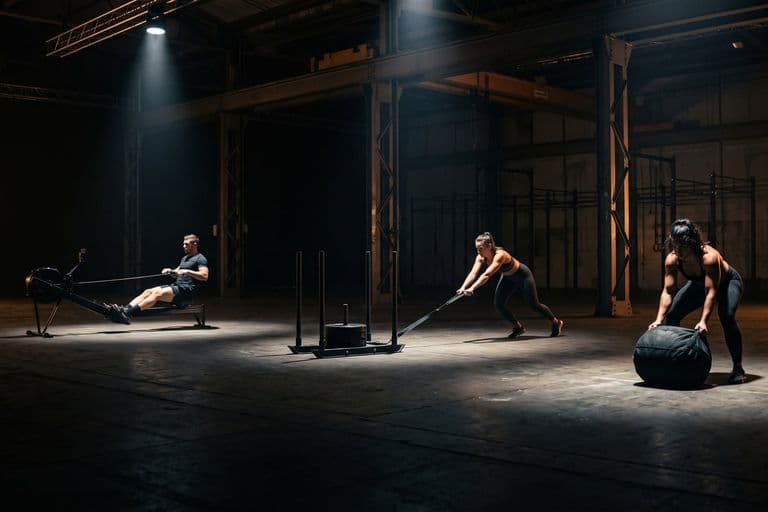
CrossFit athletes tend to do well at fitness racing, and they tend to be surprised by exactly which part hurts.
What transfers
- Work capacity. Years of intervals at high intensity is precisely the quality these races test.
- Movement competence. Sleds, carries, wall balls, machines — none of it is new.
- Discomfort tolerance. A well-trained CrossFit athlete has an unusually high tolerance for feeling terrible and continuing.
- Transitions. Moving between movements without stopping is already a trained habit.
What does not
Sustained running
This is the gap, and it is a real one. CrossFit running is mostly short and repeated: 400 m, 800 m, a kilometre at most, inside a workout. Several kilometres of continuous-ish running is a different physiological demand and it is trained by running, at length, regularly.
The pacing model
A CrossFit workout is usually a sprint: go hard, hold on, it ends. A fitness race is a much longer effort with a much lower ceiling on sustainable intensity. Athletes who pace it like a workout blow up, reliably, in the middle third.
The eight-week fix
- One long easy run a week. Genuinely easy, 45–75 minutes. This is the session that closes the gap and it is the one CrossFit athletes most dislike.
- One compromised-running session. Run–work–run intervals at race loads.
- One threshold session. Sustained, controlled, uncomfortable but not maximal.
- Keep two strength sessions. You already have the strength; do not lose it.
- Reduce metcon volume. Something has to give, and it is not going to be the running.
The gap is not fitness. It is aerobic running, and it is closed by running slowly for longer than you would like.
The mental adjustment
Fitness racing is less exciting than a competition floor. There is no unknown workout, no crowd on the last round, no leaderboard shifting in real time. It is a long, even, grinding effort that rewards discipline over aggression. Some CrossFit athletes love that. Others find out that what they actually enjoyed was the competition rather than the work.